Belgian Shrimp Fishing: The UNESCO Tradition You Need to See
This article may contain affiliate links. This means we receive a small commission whenever you book or purchase something through our links (at no extra cost to you!). You can find more information in our disclaimer.
Have you ever heard of horseback shrimp fishing? If not, you’re missing out on one of the most unique traditions in the world. And it all happens in Oostduinkerke, a small seaside town on the Belgian coast.

SUMMARY: Horseback shrimp fishing in Oostduinkerke, Belgium, is a UNESCO-recognized tradition, where fishermen use Belgian draft horses to catch shrimp. This centuries-old practice is significant to the local community and is maintained through specific training and exams. For visitors, demonstrations are held from April to October, offering an opportunity to see this unique method in action and enjoy freshly caught and cooked shrimp afterward.
Every summer, as a child, I found myself enchanted by this unique spectacle in Oostduinkerke, just a stone’s throw from my grandmother’s house in De Panne.
The town is home to a unique tradition of fishermen who use horses to fish for shrimp. This tradition has been around for centuries, once practised along the entire Belgian coast and other parts of Western Europe.
Nowadays, Oostduinkerke is the ONLY place in the world where fishermen still use horses to catch shrimps. It’s a sight that you won’t want to miss! It’s so special that UNESCO has even recognized it as an Intangible Cultural Heritage.
Let me show you why this remarkable tradition is more than just fishing. It’s a story of resilience, community, and a deep connection to the sea.
Where Does This Tradition Come From?
Horseback shrimp fishermen are a rare sight nowadays, but this 500-year-old tradition was once common along the coasts of Belgium, the Netherlands, France, and Southern England.
However, they’ve long since switched to motorized vehicles.
Farmer-fishermen would use horseback shrimp fishing as a way to make extra income.
Originally, mules and smaller horses were used but in time the fishermen switched to muscular horses such as the Belgian draft horse, which is one of the strongest horse breeds in the world.

Oostduinkerke is the only place along the Belgian coast where this tradition is still alive.
This method of horse shrimp fishing in Belgium is only possible on beaches with gentle slopes. This happens to be the natural habitat of the Crangon Crangon, the grey North Sea shrimp.
Oostduinkerke doesn’t have any obstacles on the beach that could injure the horse or fishermen, which is why the beach town is an ideal location for shrimp fishing on horseback.
How Does That Work, Shrimp Fishing on Horseback?
Shrimp fishing happens during the two hours before low tide and the two hours after, because the tide is less strong.
The Belgian fishermen work together with their strong Brabant draft horses.

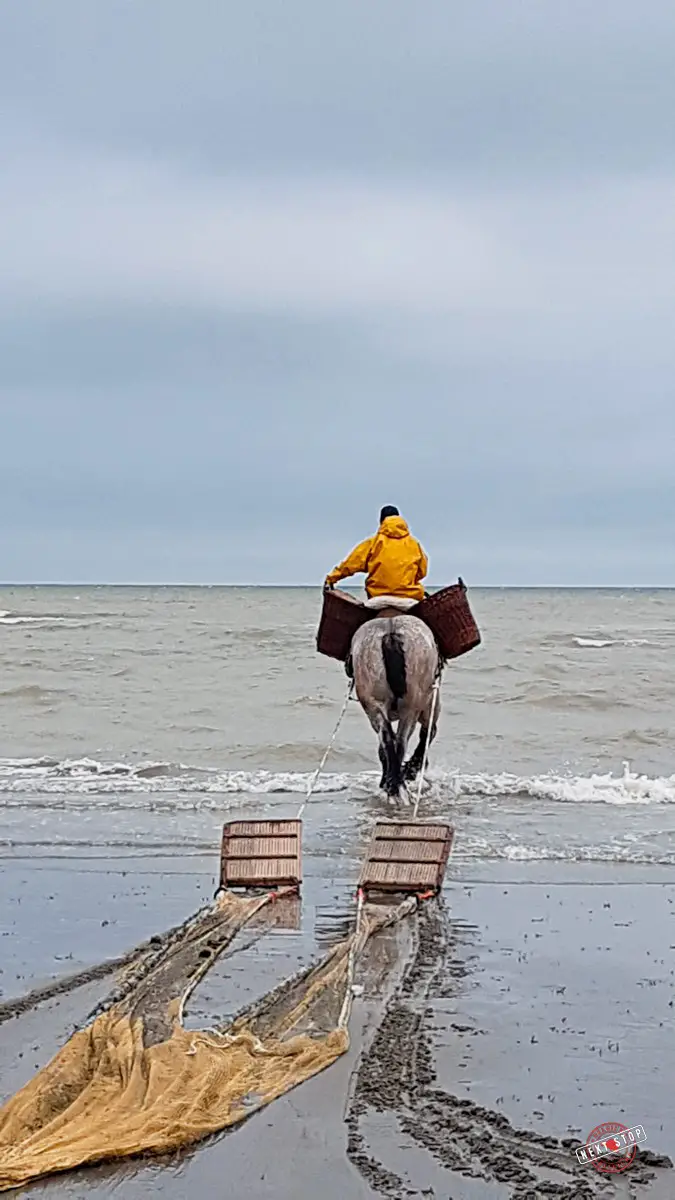
The Belgian shrimp fishing horses are directed to pull their wooden carts over to the shoreline. Once they have done so, the fishermen and their assistants start harnessing up.
The horses wear a wooden saddle and two baskets, one on each side of the saddle.
The fishermen put on their traditional shrimp fishing gear, which includes bright yellow oil gear, rubber boots, and a southwester.
After that, the shrimp anglers get on their horses and walk them in the shallow waters – up until the horses are breast-deep.

The grey North Sea shrimp live in the sand just below the surface. To catch them, the shrimp fisherman uses a net behind the horse that is held open by two wooden boards.
A chain is being dragged along the bottom, which causes the shrimps to jump up – straight into the net.
Every half hour, the shrimp fishing is interrupted so that the nets can be emptied and the shrimp caught can be sorted on the beach. The shrimp that are caught are mostly grey shrimp, also known as Crangon Crangon (I honestly didn’t know this either).
After 2 to 3 hours, the shrimp baskets are full and it’s time to head back to town.
On a regular day, a shrimp fisherman catches about 7 kg of shrimp but on a good day, that might even be 25 kg!
The shrimp are then sorted and sold at the local shrimp market – which is a must-visit when you’re staying at this part of the Belgian coast!
UNESCO Cultural Heritage
This 500-year-old tradition is one of a kind and it’s something that you won’t see anywhere else in the world.
Shrimp fishing on horseback is a practice that has been passed down from generation to generation.
And it’s because of this that UNESCO decided to recognize it as an Intangible Cultural Heritage in 2013.
According to UNESCO, the tradition deserved this status not only because it’s centuries old, but also because it’s an important part of the identity of the shrimp fishermen and their community.
It’s a tradition that is still very much alive today – in fact, it seems to become more popular every year – and one that continues to bring people together.
This collective identity plays an important role in social and cultural events in Oostduinkerke and Koksijde.
The Modern-Day Shrimp Fishermen in Oostduinkerke
Although this method of fishing is no longer common, it is still used by 17 diehard enthusiasts belonging to 12 households who appreciate the historic value of this unique form of fishing.
Each of the households has its own speciality. Some are experts in weaving nets while others have extensive knowledge of horses.

Once in a while, especially during the high season, the municipality organises demonstrations for tourists.
During these shows, a couple of fishermen and horses go shrimp fishing at the same time. Sometimes, the shrimp are cooked immediately after at the boulevard.
It’s more of a show than a real fishing moment – but we recommend going anyway! The dates and times are fixed, so you can be sure they’re there.
💡 Good to know: The demonstrations are held from April to October. You can find the calendar here.
However, twice a week, from April until the end of October, the fishermen go out to sea on their own to catch shrimp.
It doesn’t provide the fishermen a full income, so they all have ‘real jobs’ as they call it. But it’s not just a hobby or tourist attraction either – the catch of the day is sold in town.
Female Shrimp Fishermen on Horseback
Originally, women were adequate shrimp fishers, but they weren’t allowed to fish on horseback as this was a so-called ‘men’s job’.
After the recognition by UNESCO, Nele Bekaert applied to become the first female shrimp fisher.
She faced some negative reactions at first but pointed out that UNESCO holds gender equality in high esteem and was allowed as a trainee.
After 2 years of hard work, being trained by her husband who is also a horseback shrimp fisherman, she aced her exam and became the first female shrimp fisher in Belgium in 2015.
In 2020, Katrien Terryn became the second female horseback shrimp fisher.
How Do You Become a Shrimp Fisherman?
While the knowledge about shrimp fishing has been passed down from father to son for generations, since the recognition by UNESCO, it’s necessary to pass an exam before you’re allowed to call yourself a shrimp fisherman on horseback.

After a training period of 2 years, the trainees need to pass a shrimp fishing exam that consists of two parts: a theoretical and a practical part.
The theoretical training and exam take place at NAVIGO, the national fishing museum in Koksijde.
The practical part is all about shrimp fishing techniques – how to take your horse to the waterfront, how to sift the shrimp, and how to care for your horse. It’s also important to gain a good knowledge of the sea and to work on building a high level of trust with your horse.
The practical exam takes place for a jury of certified fishermen on horseback and other officials such as the mayor of the town.
If you want to become a shrimp fisherman on horseback, you’ll need to pass both parts of the exam.
To become an official horseback fisherman, you also need your own horse and official equipment for both yourself and your horse. On top of that, you also need a location at your house to sift and cook the shrimps.
It’s not an easy feat, but it’s definitely worth it! And hopefully, there will be more youngsters attracted to this craft which will help keep this tradition alive.
When Can You See them in Action?
The shrimp fishing season typically runs from April to October. During this time, you can see the shrimp fishermen riding their horses twice a week along the beach, using special nets to catch shrimp.
After a successful day of shrimp fishing, the shrimp are then cooked in fresh water in the home of the fisherman. They can choose to keep the shrimp for themselves or to sell them.
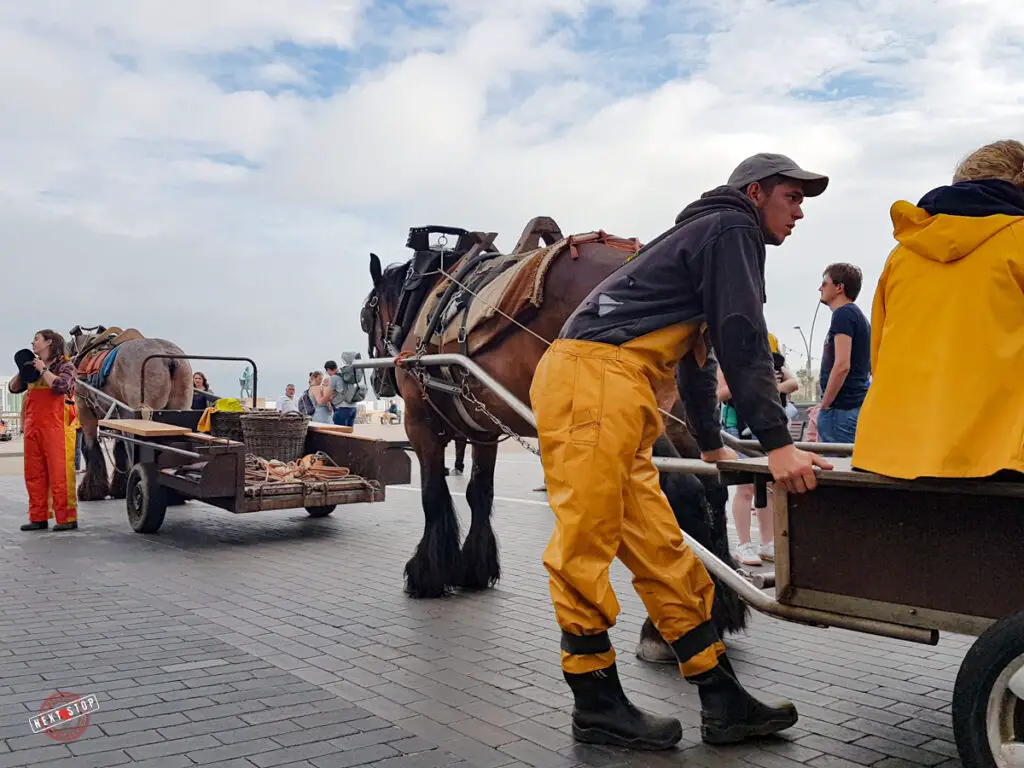
You’re free to watch the fishermen and horses anytime, but the municipality organises demonstrations too.
On these days, a large number of shrimp fishermen on horseback go shrimp fishing to show tourists how it’s done. Check the calendar here.
The demonstration usually takes around 45 minutes and starts at the boulevard. If you arrive a bit earlier, you get to see one or more Belgian draft horses and their carts up close (and you can even pet them and take a picture if you like).

At the starting time, the assembled group of horses, fishermen and visitors walk together towards the shore. The horses are prepped and the fishermen don their gear.
From the beach, you get to see the horseback shrimp fishermen in action – wading through the water and returning to shore every once in a while to sift the shrimp.
On some days, the shrimp are also cooked in metal bins on the boulevard so you can enjoy some fresh shrimp after admiring this UNESCO heritage in action!
Shrimp, an Important Part of the Belgian Cuisine
The grey shrimps that are caught in the North Sea, have been an important part of Belgian cuisine for centuries.
There are several popular dishes that you can find in any restaurant, such as shrimp croquettes (a deep-fried croquette with a creamy filling of butter, milk and shrimp)and tomate-crevette (a hollowed-out tomato filled with a mixture of shrimp and mayonnaise).
Although we recommend tasting these dishes on the Belgian coast, they are so popular that you can eat them anytime and anywhere in the country.

But if you ask the people in Oostduinkerke, the North Sea shrimps are best boiled fresh and eaten with butter on a slice of bread. Accompanied by a local Belgian beer, of course!
Shrimp Festival
The most famous celebration is the 2-day Shrimp Festival held every June.
The shrimp festival is a major event in the town’s calendar, and it attracts visitors from all over the region.
The parade is the highlight of the festival, and it features floats, street theatre and costumes made by the local community.
There’s a contest involving hundreds of children being initiated into shrimp catching, which is a popular attraction.
There are also many demonstrations of shrimp fishing on horseback in Oostduinkerke, as well as other traditional shrimp fishing techniques.
It’s a great opportunity to try this traditional Belgian dish and learn more about the shrimp fishing culture.
That’s a wrap on the Shrimp Fishermen on Horseback in Belgium
This tradition is an important part of Belgium’s coastal culture and it’s a great way to learn about the country’s history and heritage.
If you’re interested in learning more about this UNESCO immaterial heritage tradition, be sure to check out the shrimp fishermen on horseback at Oostduinkerke the next time you’re in Belgium!
It’s an experience that you won’t forget.
BELGIUM TRAVEL PLANNING RESOURCES
Getting to Belgium: Fly into one of the main international airports: Brussels Airport (BRU) or Charleroi Brussels South Airport (CRL). Take an international train to Brussels South Station. Or take a ferry to Dover or The Netherlands, then drive or take the train to Belgium.
Getting Around: For the major destinations, the train is by far the best option. You can book your train tickets here. If you’d like to visit smaller places, the most convenient way would be to rent a car. We always use Discover cars, they compare all the rental companies and give you the best rates.
Accommodation: Booking.com is the most popular accommodation platform in Belgium. It’s what I use every single time.
Guided tours: Use Get Your Guide or Viator to find fun tours in Brussels, Bruges, Ghent and Antwerp. Or Guruwalk to find free walking tours in multiple destinations.
If this helped you plan your adventure, a coffee would go a long way in fueling my next guide! 😉
