Visiting the Bluebell Forest in Belgium : Halle Forest and 5 alternatives
This article may contain affiliate links. This means we receive a small commission whenever you book or purchase something through our links (at no extra cost to you!). You can find more information in our disclaimer.
Always wanted to see the Bluebells in Belgium?
Yes – me too, that’s what got me inspired to write this article! And since I live in Belgium, seeing the Bluebells is definitely worth it!
Most tourists (thousands of visitors each year) visit them in the Hallerbos, a forest just outside of Brussels.
While it is convenient to be able to see them this close to the capital, the fame brings along big masses and a shortage of peace and quiet.
So, let’s go for this insider’s tip: there are other places where you can find a Bluebell forest and you might even be on your own for it!
Bluebells in Belgium
What are bluebells?
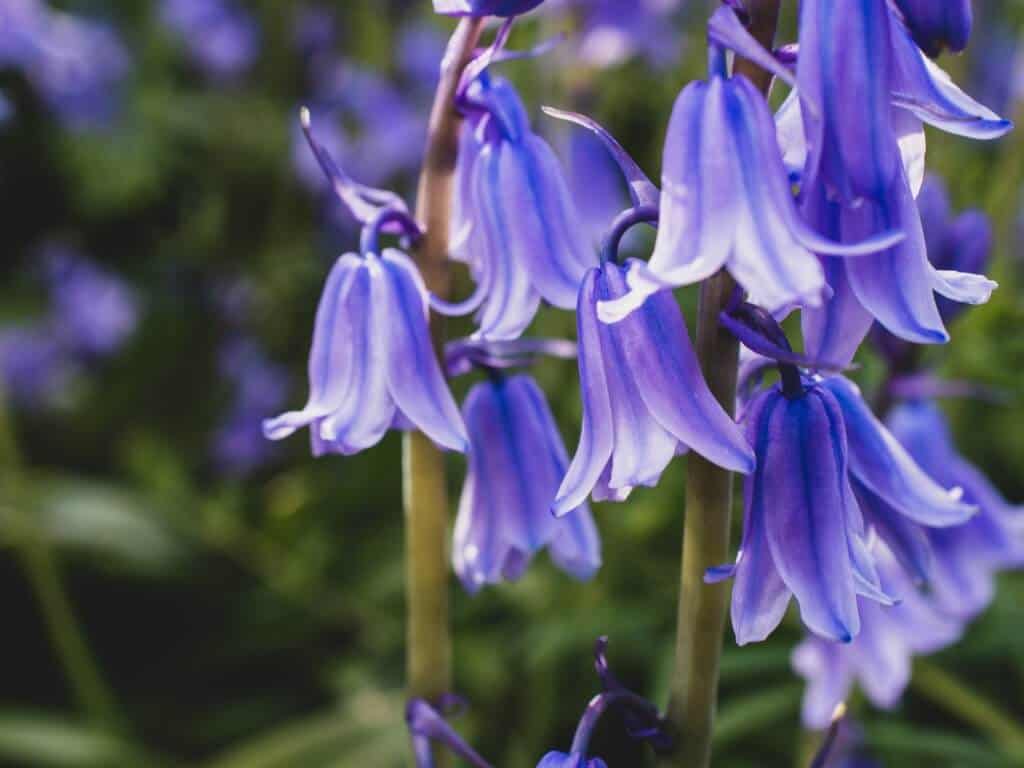
These small blue-ish purple flowers bloom in the shade of the trees in semi-dense broadleaf forests. They grow in large numbers giving the impression that the trees are standing in a sea of blue.
This is where the Hallerbos earned its nickname “the blue forest”.
🪄 Seeing this flower carpet is magnificent and feels like a fairytale (especially if the sun is falling through the leaves right on top of the flowers), however, every single flower is beautiful as well with its small hanging clocks.
The bluebells have a short blooming time. The fallen autumn leaves protect the early plants from the last frost but once the sun starts warming up, the flowers will grow and blossom.
As long as the sun can reach the forest floor, the Belgium bluebells will shine bright. However, once the buds on the oak and beech trees have turned into leaves, the bluebells will turn purple greyish and start withering.
When do bluebells bloom?

As with many flowers, the blooming time is short and a bit unpredictable. They only bloom for about 2 weeks a year!
In general, the middle of April is a good point of reference. However, the weather has a big impact: if it’s still cold in March, then the bluebells will bloom more towards the end of April and the beginning of May (like was the case in 2021). On the other hand, if March is exceptionally warm, they’re more likely to bloom at the beginning of the month.
Although it might be disappointing to miss the bluebells’ flowering time, other forest spring flowers will still turn the woods into a field of colour.
We especially love the fields of white wood anemones that bloom a little before the bluebells!
🌷 If you’re coming from further away, keep an eye on this webpage. Every couple of days you get an update on how the forest is transforming. The text is in Dutch, but they add little movies or pictures that speak for themselves. There’s also an English version, but it’s sometimes updated later than the Dutch version.
Are bluebells poisonous?
☠️ Yes, bluebells are poisonous both for humans and animals. Its sap irritates the skin which can cause itching and rash.
👮 Is it illegal to pick bluebells?
Yes, in many places it’s illegal to pick the bluebells. This is the case in Halle Forest, in the Muziekbos, and in any of the protected woodlands.
However, they sometimes grow alongside the road in which case you won’t get a fine for picking them. Although, it should speak for itself that you kill the flower by picking it.
Also, bluebells are very sensitive flowers, that’s why you’re urged to stay on the paths – as tempting as it is to go stand in the middle of the blue-purple field for that perfect picture.
By stepping on the flowers you prevent them from blossoming the next year. And what’s more, by tramping on the floor around the flowers, you prevent the new seeds from growing 🌱.
Are bluebells always blue?
Most bluebells have a bright blue-ish and purple colour. But you can also find white ones. There’s a light pink version as well, but those are pretty rare.
Can I step in between the bluebells to take a picture?


Bluebells are absolutely gorgeous and you can spend hours trying to make that one perfect picture. However, always, always stay on the path to do so!
Bluebells are very sensitive flowers, that’s why you’re urged to stay on the paths. As tempting as it is to go stand in the middle of the purple field for that perfect picture, by stepping on the flowers you prevent them from blossoming the next year.
⚠️ Even tramping on the floor around the flowers – so not even ON the flowers – will prevent the new seeds from growing. And if the bulb gets hit, it will take 5 years for it to bloom again!
As you can see, the bluebells are at risk of becoming endangered due to their own success. So, be responsible and stay on the paths!
Where can you find the Bluebell forest?
Hallerbos
Hallerbos Belgium is the most well-known location to see this natural spectacle and the place where thousands of visitors gather each year. On a sunny weekend day, this may result in rows and rows of people waiting for their turn to see the bluebells in spring.
💡 Should you be living in Brussels, we recommend you choose a weekday for your visit!
The bluebell spectacle is definitely the largest in Hallerbos Forest Belgium – covering a whopping 300 hectare.
The history of Hallerbos Forest Halle Belgium
Hallerbos is part of an ancient forest that once stretched all the way from the river banks of the Rhine and the Moselle to the North Sea. In time, it got smaller and smaller with an absolute low during World War I, when the Germans cut down many trees to make room for trenches.
However, The Belgian state acquired the forest in 1929 and has been slowly expanding it again.
🌳 At this time, Halle Forest covers 535 hectares of which about 100 hectare is a Natural Reserve.
Walking in Halle Forest Belgium
During the year, there are 3 marked walking routes through the forest. You can get a free walking map at Halle’s tourism office or you can download it here.
- The shortest and easiest one is the “8 dreven” walk. This 1,8 km route is accessible for wheelchairs and is marked by black and white poles.
- The Sequoia walk is 4 km long and is marked by blue poles.
- The Roebuck walk is marked by yellow poles and is 7 km long.
During the Bluebells bloom time, there are 2 marked Bluebell walks as well. You can download the map here.
Practical information
Visiting the blue forest Belgium is free. Throughout the forest, you’ll find QR codes. If you scan those with your smartphone, it’s possible to make a donation that will be used to safeguard the bluebells.
If you want to reach the forest by car, there are many free parking places available. During the bluebell high season, you’re most likely to find a spot at parking nr. 1 and 11 as those are the biggest ones. Pro tip: a couple of the parking lots are closed during the bluebell season.
You can also reach the Hallerbos Halle by public transport. At the weekends during the high season, free shuttle buses will bring you from Halle Station to the forest and back. There’s one every 30 minutes. Reaching Halle Forest at regular weekends using public transport isn’t easy. However, during the week, you can take TEC bus nr 114 and get off at stop Vlasmarkt (from there it’s a 4-minute walk to the Forest Museum).
The ultimate option is to rent a bike to get to the forest. There are Blue Bikes available at Halle Station and it’s about 5 km to Hallerbos.
5 Best alternatives
Although you can find bluebells in the Western part of Belgium, the best alternatives for the Halle Forest can be found in the Flemish Ardennes region.
Brakelbos (Brakel)
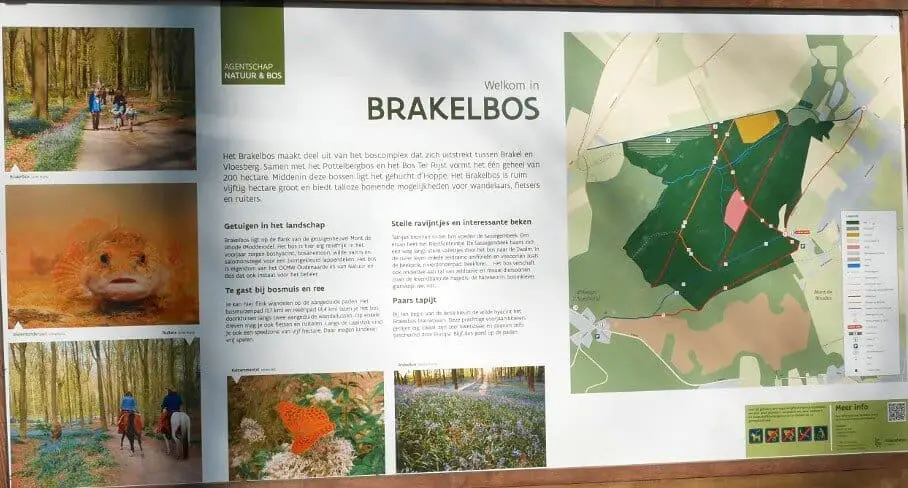
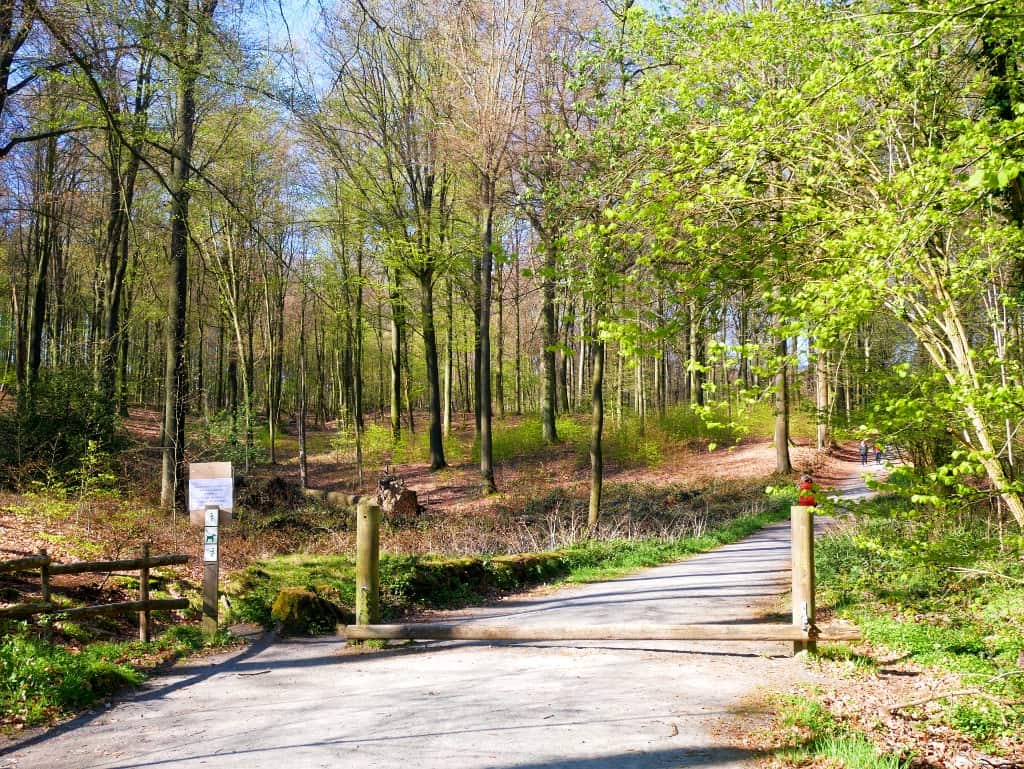

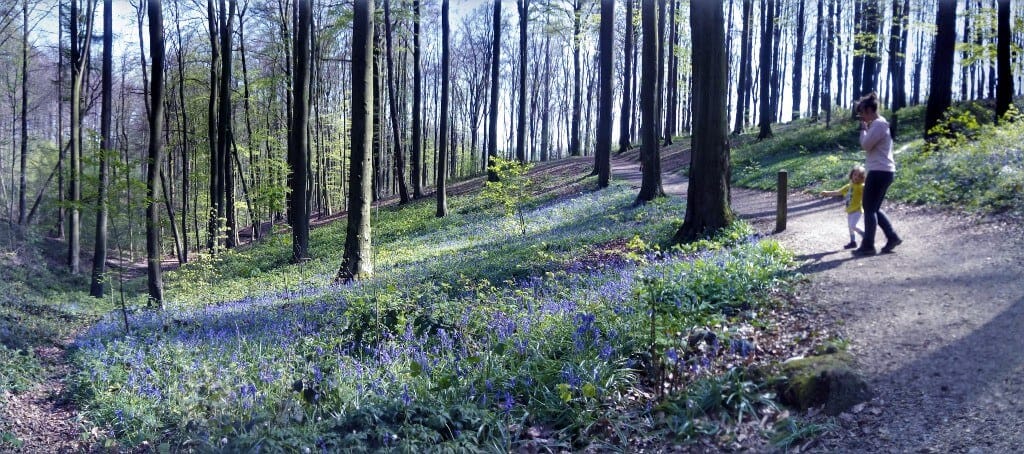
This is our favourite location to see bluebells in Belgium. Ok, it might have something to do with the Brakelbos being only a 10-minute drive away from our home, but still.
This 52-hectare big forest is still pretty unknown (although things might be changing post-Covid), so you might find yourself alone to enjoy the bluebells if you’re visiting during the week.
It’s a little busier during the weekend, but still much more enjoyable than the Hallerbos or the Muziekbos.
Although not such a big forest, Brakelbos merges into Bos Ter Rijst, Bois de la Houppe/Pottelbergbos, and Bois de la Louviere/Livierenbos. This way, one large forest exists stretching over the border between Flanders and Wallonia.
- 🥾 There are 2 marked paths in the forest: the Wood Mouse path and the Deer path, both are marked with their respective animals
- 🥾 There are 2 entrances to the forest: the first is in the Brakelbosstraat. There’s also a small parking lot. The second entrance is in D’hoppe. You can find a couple of restaurants along the road and there’s more parking space here.
Muziekbos (Ronse)
Het Muziekbos is another favourite of ours, not in the least because we can see it from our backyard!
It’s a great place to see the bluebells, although there aren’t as many as in Het Brakelbos. However, Het Muziekbos is an amazing forest with many hills and a beautiful fairytale tower.
Whenever your walk goes outside of the forest, you’ll have the most glorious hillside views!
🌳 It is one of the more famous forests in Flanders, which means you won’t be alone if you’re visiting during the weekend. Parking space is also often a problem, your best bet is to look for a spot in the hamlet Louise-Marie.
🍽️ Don’t forget to grab a drink or a bite after your walk at Bistro Boekzitting – the food is excellent. Another option, especially with kids, is to go downhill to De Ijsmolenhoeve. This petting zoo has great ice cream and a large playground.
🥾 There are no longer marked walking routes throughout the forest. They now all use the walking route numbers you can find throughout Flanders.
💡However, this map still shows the 4 different routes you could find: Boekzittingpad (1.4 km), Geuzentorenpad (2 km), Muziekbosroute (10.2 km), and Taalgrenswandelroute (12.8 km).
Raspaillebos (Geraardsbergen)
This colourful forest is another good option to see the bluebells. Many other spring flowers love the hilly woods, so don’t worry if you’re a little late or early for the blue sea spectacle, there’ll be plenty of other fields of flowers to see.
As it’s located on one of the highest hills in the region, you can expect the walks here to be pretty spicy.
🦅 There’s also a large population of birds of prey in this forest, so keep your eyes open!
🥾 There are no less than 5 marked walks in Het Raspaillebos: De Bosbergwandeling (2 km), Venster op het landschap (2,5 km), Raspailleboswandeling (3,7 km), Boerenlandschap (4 km) and Aardgaswandeling (7,7 km). You can see the different colours on this map.
🚗 There are 3 parking spots: the first in Hoogvorst and the others on the top of the Bosberg.
Kluisbos (Kluisbergen)
Het Kluisbos is the largest forest in the area, with a whopping 300 hectares. It’s one of the most famous ones in Flanders and therefore attracts quite a bit of visitors.
🏔️ As it is situated at the Kluisberg (berg means mountain/hill), the walks here are hard on the calves as well.
In spring, large areas of the forest colour blue thanks to the many bluebells. Apart from the glorious old trees and beautiful flowers, you can find a couple of sights in this forest.
Make your way to the top for The Tower, a strange building that functions as a watchtower in the Napoleon era. More downhill, you’ll meet Peetje & Meetje (gran and gramps) – two remaining pedestals from an ancient altar of sacrifice.
Pass De Vierschaar, a place that was used to speak justice. The alderman, the accuser, the accused and the defender took place on these 4 blocks.
Ultimately, step your feet into the Love Source and according to the legend, you’ll meet your true love in the next year.
🚗 You can park your car at Parking Kluisbos in Enclus du haut, in the Fazantendreef, or along the Torendreef.
🍽️ There are many restaurants and terraces to give your legs a rest after your walk. At the top, you can find fairytale-like Bosbaar and Las Acacias, a great spot for kids overlooking the natural play zone.
🥾 Like the Muziekbos, the formerly marked walking routes were replaced by the numbered walking paths through Flanders. You can still see them on this map though which might give you an idea.
Kravaalbos (Aalst)
The last alternative for the bluebells in Halle’s forest Belgium is Het Kravaalbos. This 80-hectare big forest has a diverse landscape and will let you enjoy the bluebells in all their glory.
🥾 3 marked routes allow you to discover the woodlands. No weird or catchy names in this case, but just a yellow (3,2 km), blue (3,8 km), and red (4,2 km) walk.
🚗 You can enter the forest in the Putstraat in Meldert (Aalst). Parking is possible in this street or in the centre of Meldert.
Where to stay to see the bluebells
If you would like to see the bluebell forest Belgium in Halle, your best option is to either stay in Halle or Brussels as the capital is only a 15-minute train ride away. In Brussels, we love the Pillows Grand Boutique Hotel and in Halle, a great choice is B&B Kaai 16 which serves a delicious homemade breakfast. For other hotels in Brussels, you can also check our article for the best hotels in Brussels City Centre.
However, if you’d like to visit one of the locations in the Flemish Ardennes, a great base is B&B Het Stille Genoegen. This relaxed place is situated within walking distance of Brakelbos but all the other forests are within a short driving distance. You can read our full review here.
Frequently Asked Questions
What does Hallerbos mean?
The name Hallerbos means “the forest of Halle”. It Comes from its location in the municipality of Halle. Hallerbos is a known forest in Belgium because of its spectacular display of bluebell flowers each spring.
What animals live in the Hallerbos?
The animal that lives in the Hallerbos forest includes deer, foxes, badgers, rabbits, squirrels, birds such as woodpeckers and thrushes, and wild hares. The Hallerbos is also home to amphibians like frogs and toads, reptiles like snakes and lizards, and invertebrates like dragonflies. Due to its abundance of flora and fauna, it provides a rich habitat for these animals.
What plants are in the Hallerbos forest?
Different kinds of plants can be found in the Hallerbos forest, including wood anemones, wood sorrel, wood spurge, wild garlic, sweet woodruff, ferns, Broad-Orchids, yellow dead-nettle, lingonberry, herb-Paris and lastly, the bluebells spreading like a carpet in the forest.
What month are bluebells out?
Bluebells typically come out at the end of April and the beginning of May. This is because bluebells need warm temperatures to grow, which occurs in late spring. As the days get warmer, more bluebells will bloom, with peak blooming toward the end of May.
What kind of trees are in the Hallerbos forest?
Hallerbos forest is a wooded area in Belgium. It is home to various trees, including beech, oak, sessile oak, larch trees, maple, hemlocks, pine trees, giant sequoia, and ash trees. These are just the common trees you can find in the Hallerbos forest.
How big is Hallerbos forest?
The Hallerbos forest covers an area of about 1,360 acres (552 hectares). It is situated in the municipality area of Halle, which is in Flemish Brabant, with a small part extending into Walloon Brabant.
Are you allowed to pick up the bluebell?
No, visitors are not allowed to pick the bluebells in Hallerbos forest. The forest is protected by law, and picking flowers or other plants is illegal. Also, walking off-trail or trampling on the bluebells can damage the forest’s fragile ecosystem. So, stay on the marked paths to ensure the flora and fauna remain undisturbed.
BELGIUM TRAVEL PLANNING RESOURCES
Getting to Belgium: Fly into one of the main international airports: Brussels Airport (BRU) or Charleroi Brussels South Airport (CRL). Take an international train to Brussels South Station. Or take a ferry to Dover or The Netherlands, then drive or take the train to Belgium.
Getting Around: For the major destinations, the train is by far the best option. You can book your train tickets here. If you’d like to visit smaller places, the most convenient way would be to rent a car. We always use Discover cars, they compare all the rental companies and give you the best rates.
Accommodation: Booking.com is the most popular accommodation platform in Belgium. It’s what I use every single time.
Guided tours: Use Get Your Guide or Viator to find fun tours in Brussels, Bruges, Ghent and Antwerp. Or Guruwalk to find free walking tours in multiple destinations.
If this helped you plan your adventure, a coffee would go a long way in fueling my next guide! 😉
