
The National Flower of Belgium: Red Poppy
This article may contain affiliate links. This means we receive a small commission whenever you book or purchase something through our links (at no extra cost to you!). You can find more information in our disclaimer.
Did you know that the Red Poppy is the National Flower of Belgium?
Belgium, located in the heart of Europe, boasts a rich history and culture with numerous national symbols that reflect its past and present.
Among these symbols, the red poppy holds special significance for the country and its people.
In this article, we will delve into the history and meaning of the red poppy, as well as explore other essential national symbols of Belgium, revealing some interesting facts about this remarkable country.
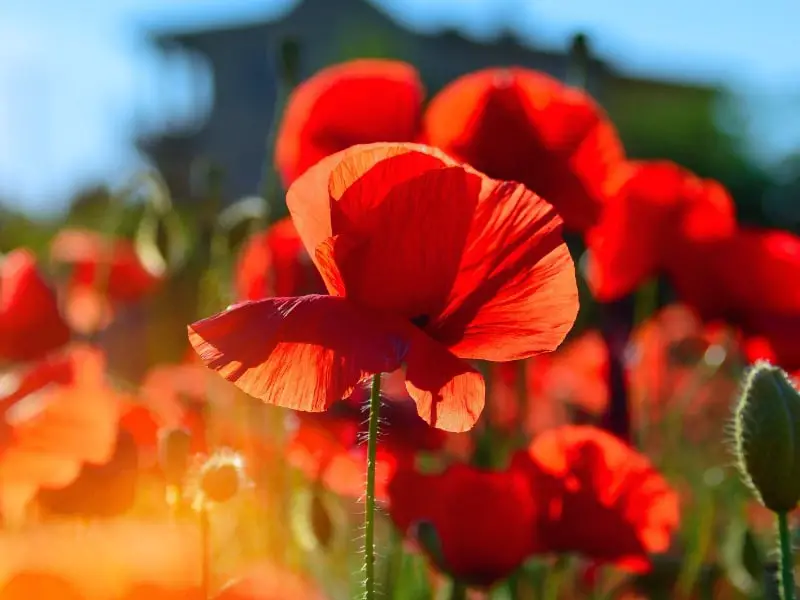
Why is the Red Poppy the National Flower of Belgium?
The Red Poppy is widely accepted as the national flower of Belgium.
💡 BRIEF FACTS
✔️The flower’s vibrant red colour and iconic shape symbolize resilience and hope for many Belgians.
✔️ It is deeply associated with Belgium due to its important role in the country’s history. During World War I, the fields of Flanders in Belgium witnessed some of the deadliest battles of the war. It was in these fields that the red poppies grew in large numbers.
✔️ The red poppy became a symbol of remembrance, tracing its roots back to the poem “In Flanders Fields” by Lieutenant Colonel John McCrae, M.D. McCrae was a Canadian physician who served as a brigade surgeon during the war.
✔️ He was inspired to write the poem in the spring of 1915 when he saw the bright red poppies growing among the graves of fallen soldiers in Flanders, Belgium.
✔️ The sight of the poppies inspired him to write the poem, which talked about the poppies blooming between the graves of fallen soldiers and encouraged people to remember the dead by wearing a poppy.
✔️ Since then, the Red Poppy has become an important symbol of remembrance for those who have died in the war, and it is often worn during Remembrance Day or Poppy Day events around the world.
✔️ The red poppy came to symbolize the blood shed during battle following the publication of the wartime poem “In Flanders Fields.”
✔️ The British Legion began selling artificial poppies to raise money for veterans in need in 1921, and it has been an annual event ever since.
✔️The poppy has also inspired the design of several other commemorative poppies that observe different aspects of war and peace.
The Red Poppy
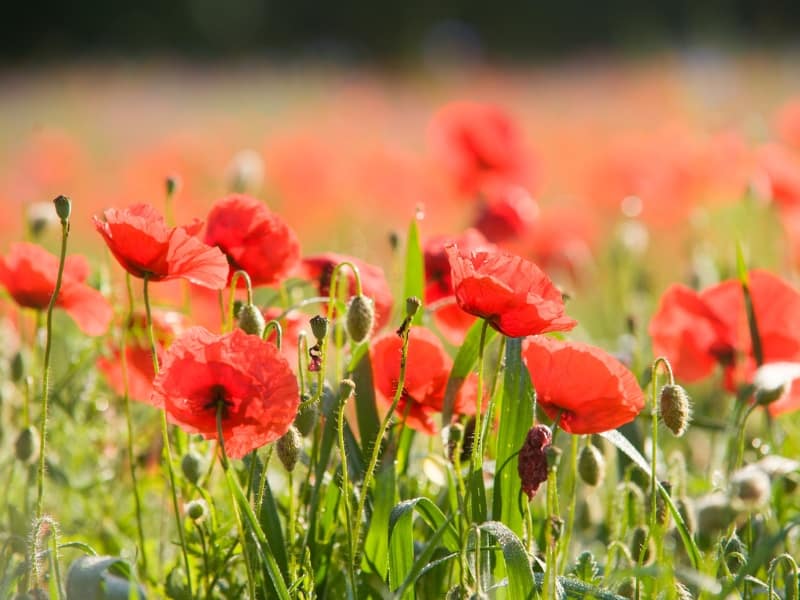
💡 Biological Name
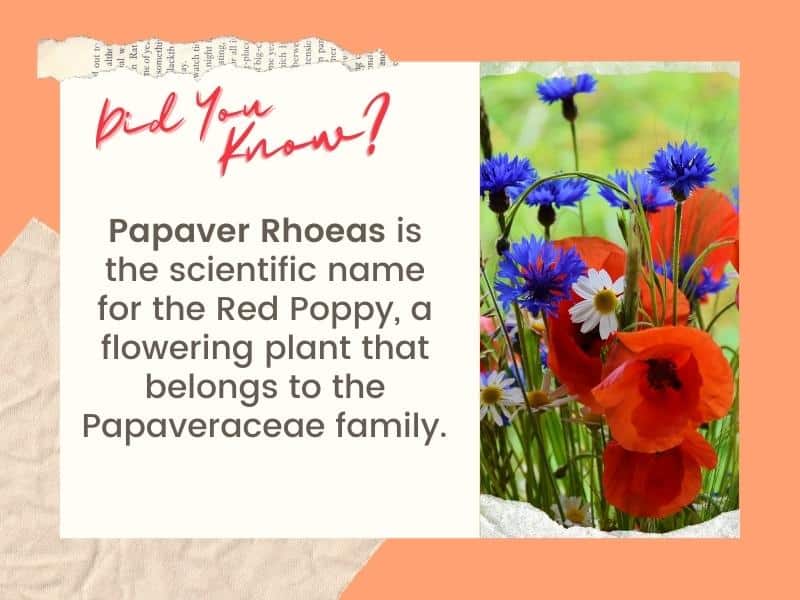
Papaver Rhoeas is the scientific name for the Red Poppy, a flowering plant that belongs to the Papaveraceae family.
This annual herbaceous species is also known as the common poppy, corn poppy, field poppy, Flanders poppy, and corn rose.
The Red Poppy has a wide distribution area, from Africa to temperate and tropical Asia and Europe, and it is a temperate native.
It has been used for medicinal purposes since ancient times and has various common names across the world.
💡 Origin
Red Poppy is believed to have originated in the Eastern Mediterranean region and spread throughout Europe and other parts of the world through human cultivation and naturalization.
It is an adaptable plant that can grow in a wide range of soil conditions, including poor quality and low-nutrient soil, and even notoriously challenging locations such as cracks in a driveway.
The Flanders Poppy is an attractive and popular feature of the countryside and features showy, vibrant red flowers that are generally in shades of brilliant scarlet-red but can also be pink or white.
💡 Physical Characteristics
The Red Poppy is an annual herbaceous species.
Its physical characteristics include lobed or dissected leaves, milky sap, and solitary stalks bearing nodding buds.
The flowers of the Red Poppy have four to six petals and numerous stamens surrounding the ovary.
The two sepals usually drop off as the petals unfold.
The species is regarded as an agricultural weed due to its ability to grow in disturbed soil and compete with crop plants.
💡 The meaning of the Red Poppy
The Red Poppy holds significant meaning as a symbol of remembrance for those who have lost their lives in wars and conflicts, particularly associated with the First World War.
It is also used as an honorary symbol to show respect for the deceased.
Apart from that, the Red Poppy represents hope for a peaceful future and support for the Armed Forces community.
Wearing the red poppy is a personal choice that reflects individual experiences, and it is also used as a means of fundraising for the Poppy Appeal, a yearly initiative to collect funds in the weeks leading up to Remembrance Day.

Fun Facts about the Red Poppy
🌸 The idea of wearing a poppy flower in memory of the war dead was popularized by Moina Michael in 1918.
🌸 Eating even a tiny amount of food containing poppy seeds can lead to a positive drug test for opiates due to the presence of morphine in poppy seeds.
🌸 The poppy plant can grow up to 1 meter (3.3 feet) tall with flowers up to 15 centimetres (6 inches) across.
🌸 There are many different species of poppy, with colours ranging from deepest purple to red, orange, yellow, and white.
🌸 The Poppy Factory was founded in 1922 by Major George Howson to provide employment opportunities for disabled servicemen, and it still produces remembrance poppies to this day.
More Belgian National Symbols
📍 The National Flag of Belgium features black, yellow, and red colours that are symbolic of the country’s coat of arms, which were taken from the arms of the Duchy of Brabant.
📍 The Belgian Coat of Arms showcases a golden lion against a black shield, with the royal crown resting on top. The motto “L’union fait la force” (strength lies in unity) is inscribed in golden letters on a ribbon below.
📍 The National Animal of Belgium is the lion, which is shown on the emblem of the country.
📍 The National Bird of Belgium is the common kestrel.
📍 The National Tree of Belgium is the Taxus Baccata, also known as the European Yew.
FAQs
What is the national flower of Brussels?
There are currently two symbols of Brussels, both of which depict the Iris pseudacorus (yellow iris) flower native to the Brussels area, as their flag and emblem. Therefore, the yellow iris can be considered the national flower of Brussels.
What do poppy flowers symbolize?
Poppy flowers are commonly associated with death and war, particularly in relation to honouring those who have died in conflicts such as World War I. In some cultures, the poppy is also associated with sleep or eternal rest.
Why do countries wear the red poppy?
The red poppy is worn by many countries as a symbol of remembrance and tribute to those who have served and died in the military. The tradition of wearing the red poppy started after World War I, when the flower became a symbol of the sacrifices made by soldiers on the battlefield. The red poppy is most commonly worn on Remembrance Day, which is observed on November 11th in many countries to commemorate the end of World War I.
Which countries wear the red poppy?
The red poppy serves as a symbol of remembrance in multiple countries, such as the United Kingdom, Canada, Australia, New Zealand, and the United States. Typically, in these countries, the red poppy is worn during the weeks leading up to important dates like Remembrance Day (November 11th), Memorial Day (last Monday in May), and Anzac Day (April 25th).
ARE POPPIES NATIVE TO BELGIAN?
Yes, poppies are native to Belgium, and the red poppy (Papaver rhoeas) is the national flower due to its significance in the country’s history. The poppies of Flanders Fields symbolise the remembrance of soldiers who died in World War I.
Where can I see poppies in Belgium?
You can see poppies around Flanders Fields’ battlefields, cemeteries and memorials. These areas are popular tourist destinations where visitors can learn about World War I history and see plenty of poppies in bloom.

Wrapping up: The national flower of Belgium
To summarize, the red poppy is not just a pretty flower, but it carries immense significance for many countries around the globe.
For Belgians, it symbolizes remembrance of those who sacrificed their lives during wartime, as well as hope for a peaceful future.
By delving into the history of how the red poppy became Belgium’s national flower, we have gained insight into the country’s cultural and historical background.
Additionally, this article has explored other critical national symbols of Belgium, including the national flag, coat of arms, animal, bird, and tree.
It is evident that Belgium is a nation that holds its cultural heritage and traditions in high regard, and its national symbols reflect its pride and respect for its past.
📌 PIN THIS ARTICLE FOR LATER!

BELGIUM TRAVEL PLANNING RESOURCES
Getting to Belgium: Fly into one of the main international airports: Brussels Airport (BRU) or Charleroi Brussels South Airport (CRL). Take an international train to Brussels South Station. Or take a ferry to Dover or The Netherlands, then drive or take the train to Belgium.
Getting Around: For the major destinations, the train is by far the best option. You can book your train tickets here. If you’d like to visit smaller places, the most convenient way would be to rent a car. We always use Discover cars, they compare all the rental companies and give you the best rates.
Accommodation: Booking.com is the most popular accommodation platform in Belgium. It’s what I use every single time.
Guided tours: Use Get Your Guide or Viator to find fun tours in Brussels, Bruges, Ghent and Antwerp. Or Guruwalk to find free walking tours in multiple destinations.
If this helped you plan your adventure, a coffee would go a long way in fueling my next guide! 😉
